Writers: Subscribe and send in your brief bio and your best writing sample (up to 1200 words total) to apply to become a featured writer. Find free articles and markets to help you get published. Readers: Find your favorite author, anthology, and great reading. Editors, send in you calls for manuscripts. Find writers and manuscripts for your anthology.
Writing Inspiration










 On Writing Well: The Classic Guide to Writing Nonfiction
...should
be required reading. Simplicity is Zinsser's mantra: he preaches a
stripped-down writing style, strong and clear. Simple truths that published
writers use.
On Writing Well: The Classic Guide to Writing Nonfiction
...should
be required reading. Simplicity is Zinsser's mantra: he preaches a
stripped-down writing style, strong and clear. Simple truths that published
writers use.
|
|
With contributions from Ernest J. Gaines, Terry McMillan, Sue Grafton, Steve Allen, George Plimpton, and Ray Bradbury.
|
 2003
Writers Market Find the
markets that want to pay you for what you write. the best-selling writing
title each and every year. 2003
Writers Market Find the
markets that want to pay you for what you write. the best-selling writing
title each and every year. |
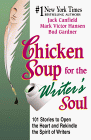 Chicken Soup for the Writer's Soul:...
What Do Women Want? / What Do Men Want?
What (do) Women Want in From Men./? Use your own original voice. Send your best work in the body(that means no attachments) of your e-mail with "Relationship Anthology" in the subject line to Submit to What Women Want / What Men Want
|
Telecommute: FREE report, FREE market tips, FREE bulletins
|
|
|
|
| Take advantage of print on demand technology to see your book in print fast. We provide custom design, distribution. Discover how by clicking now. | |
|
|


Complete Article with Resource Box at end:
FIVE STEPS TO CONCRETE CREATIVE FICTION
by Jennifer Turner
The brainstorm hits like a monsoon. Your muse is screaming in your
ear. The world fades into a tapestry of forgotten dust bunnies and
dirty dishes. You have an idea! But suddenly, the evil specter of
indecision rears its ugly head and your bottom lip becomes a gnashing
pad while you ponder the problem of just how to get that story down.
Sound familiar?
Whether you're working on a short fiction piece or a full length
novel, these steps will enable you to clearly see the story. For a
longer work, apply these steps to each scene, for shorter fiction,
utilize each step for the entire plot and exterminate confusion.
Step One–Cement the Story
Decide what your story is about. Be specific. Abstract generalities
will confuse the matter. Love, justice, revenge–those are interesting
concepts, but they aren't specific enough to give your brainstorm the
push it needs. Describe in one sentence what you're story is about.
This is your mission statement.
"A nerd named Jim embarks on many athletic adventures in order to
meet women."
Place the statement where you can see it when working. Post-it notes
are wonderful critters and can be exchanged easily when switching
projects. Everything from here on out must apply to that sentence. It
is the diamond-head focus of our endeavor.
Step Two–The Beginning, Middle, and End
Once you understand who your lead is and what they're doing, you must
come up with a beginning, a middle, and an end. If you despise
outlines or enjoy writing by the seat of your pants, this can be a
minimal sketch of the turning points in your story. For those who
find comfort in knowing which plot point needs to be set up, this can
be a full outline. However, one should never proceed without a
clearly marked path. As you wouldn't set off on a long journey
without a map, you shouldn't let your muse run willy nilly through
your plot. With direction, the tale will unfold in a logical manner.
Write one sentence for each segment of the story.
"In the beginning, Jim discusses his plans with a sporting goods
salesman."
"In the middle, Jim learns athleticism is not his forte and tries for
a less skilled sport."
"In the end, Jim is roughed up from his misadventures, but a sky-
diving poster inspires him to try once more."
Step Three–Watch, Listen, and Remember
Ever read a story that was basically good, but lacked realistic
dialogue, or internal thoughts you could relate to? Did you feel
disconnected from a tale you might otherwise have enjoyed? Avoid
creating the same distance by learning to watch, listen, and
remember. Keep a notebook for jotting down interesting thoughts or
observations. Watch how people use body language to show emphasis, or
to punctuate their remarks. Listen to the words people choose when
speaking and which words they don't use. Pick your own brain for
memories and utilize them to create a sense of familiarity for the
reader.
Make a list of plot related items and keep them handy when moving
through the different stages of the story. Each item will offer you
inspiration, though you may not use all items on the list. Ten is
good for a short story or for a single scene in your novel. The list
need not be much more than a few idea cementing words, as in these
five;
"A park smells like pine"
"Snow melts through denim and leaves the skin beneath red"
"Horses blow through their nose"
"A sporting good's store at the mall has Muzak piped in"
"A bruised lip feels twice its size"
Step Four–What If?
This is the fun part. Now that you've got the who, the what, the
where, and the why, you can brainstorm the how. Playing the what if
game will allow your story to be unique, stand on it's own, allow the
reader to keep guessing and keep reading. The last thing any author
wants to write is "another" story. They want their tale to be an
original.
Begin with your opening scene and brainstorm how many ways you could
show those details. What if Jim is clueless and the salesman takes
him under his wing? What if this salesman sees a great opportunity to
gain commissions from Jim's failures? What if our hero decides the
salesman is just the gigolo mentor he's been hunting for?
When writing your list of what if's, you'll likely find your second
or third idea is much better than the rest. From this list you can
cull a series of threads that add depth to your tale and surprise the
reader. Build suspense by delivering events the reader won't expect.
Step Five–Lie Well
Great authors, in essence, are great liars. In order to learn to lie
well, you must craft your tale in a way that is logical and suspends
disbelief. As you would never tell your neighbor the grass hasn't
been mowed because mad geese were blocking your every attempt, don't
show a series of events that insults the intelligence of your reader.
Jim can't learn to scuba dive in the sporting goods store–and likely,
they don't have all the equipment he needs. But they do have skis,
roller blades, and a host of other equipment to choose from. Jim
can't break a leg skiing one week, and then go to a dude ranch the
next. But, he can suffer bruises and scrapes from a close encounter
with a pine tree and continue his quest.
Keep the audience uppermost in your mind. What will the reader think
of this? How will they react? If I were reading this, what would I
expect to happen next? Take it even further and ask yourself if what
you've planned to happen will delight the reader, or kill their
interest.
Once you've discovered the key to your tale and how to make the
reader believe what you're sharing with them, you'll have a work
ready for success. Remember to play fair with the audience and
connect every word to the story in a way that inspires confidence. If
the reader thinks the work lacks credibility, they'll lose interest
and never finish. Your list of observations will go a long way in
creating a bond with the reader which will not only allow them to
enjoy the story, but inspire loyalty to you, the author.
Author of dozens of articles and award winning short stories,
Jennifer Turner offers caring and concise critiques for aspiring
authors without the high cost of big business editorial services at,
ROTO-WRITER CRITIQUE SERVICE
http://jturner.00books.com/index.html
