Anthologies Online, where editors, writers and readers converge.
http://www.anthologiesonline.com/
Meet here to get published and to create anthologies:
Writers: Subscribe and send in your brief bio and your best writing sample (up to 1200 words total) to apply to become a featured writer. Find free articles and markets to help you get published. Readers: Find your favorite author, anthologies, and great reading. Editors, send in your calls for manuscripts. Find writers and manuscripts to fill your anthologies.









 Christian Writers' Market Guide 2004
Do you
want to get your work published–or keep your work published–but you
don’t know where to start? Find current information on over 1,200 markets
for the written word.
Christian Writers' Market Guide 2004
Do you
want to get your work published–or keep your work published–but you
don’t know where to start? Find current information on over 1,200 markets
for the written word. |
|||||||
|
|
|||||||
 The
Writer's Handbook, 2004 (Writer's Handbook)
For
writers who want a reliable one-stop source of top-notch professional advice
and quality paying markets. Over over 1,000 pages of essential information,
how-to advice, and paying markets they won't find anywhere else! Find 3,000 quality book and magazine markets,
along with updated details and contact information, and much more. New to
this 2004 edition are dozens of "quick-look" checklists for writing,
selling, and organizing work more efficiently, as well as extensive sidebars
with tips for submitting work for publication, writing queries, and more. The
Writer's Handbook, 2004 (Writer's Handbook)
For
writers who want a reliable one-stop source of top-notch professional advice
and quality paying markets. Over over 1,000 pages of essential information,
how-to advice, and paying markets they won't find anywhere else! Find 3,000 quality book and magazine markets,
along with updated details and contact information, and much more. New to
this 2004 edition are dozens of "quick-look" checklists for writing,
selling, and organizing work more efficiently, as well as extensive sidebars
with tips for submitting work for publication, writing queries, and more. |
|||||||
|
|||||||
|
|||||||
| Start training now for a rewarding career as a Freelance Writer. In as little as nine months, you could be writing articles and stories for magazines, newspapers, and more — and making money doing it. | |||||||
| New Writers Magazine: Committed to helping you get published | |||||||
|
2004 Christian Book Writer's Market
Guide
Buy 1 Item, Get A Second Of Equal Or Lesser Value At 50% Off! Enter Code 970598. (Valid Through 09.18.04)Click here |
|||||||
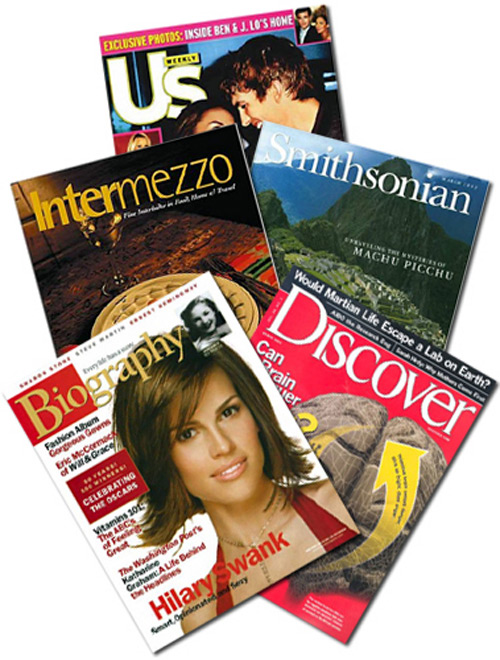  Magazine Samplers
--Most available for international delivery
Subscribe based on the types of markets you want to write for and get a
different magazine every month. Choose from
cooking,
parenting,
business,
health and more. A great way to study markets where you should be
be publishing. Magazine Samplers
--Most available for international delivery
Subscribe based on the types of markets you want to write for and get a
different magazine every month. Choose from
cooking,
parenting,
business,
health and more. A great way to study markets where you should be
be publishing. |
|||||||
 Save up to 50% on computers
|
|||||||
|
Latest Freelance Jobs (new work-at-home jobs you can apply for now): To get instant access to these and hundreds
of other work-at-home freelance jobs, click here. |
|||||||
Inkjet Cartridges starting at $3.99!!! All-Ink.com |
|||||||
 |
|||||||
| Click here if you want a job in Hollywood! | |||||||
|
|





Parts of Speech
|
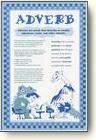
ADVERB
Adverbs are words that describe or modify
adjectives, verbs, and other adverbs. |
 ADJECTIVE ADJECTIVE
Adjectives are words that describe Adjectives are words that add life to sentences. When you're trying to find
them in a sentence, look for the words that describe what things are like.
Adjectives answer these questions in a sentence: What kind?, How much?,
Which one?, and How many? There are five kinds of adjectives. |
|
Pronouns keep you from having to repeat the same nouns, pronouns, or names
over and over. The word that the pronoun replaces is called the
"antecedent." There are many types of pronouns.
*Relative pronouns are words that start a
clause or phrase within a sentence. These include: that, which, who, and
those. Example sentence: I never knew the man who carried the striped
umbrella. *Indefinite pronouns are used to indicate people, places, or things without pointing to any particular one. Examples: anyone, everybody, both, either, something, nothing, any, all.
|
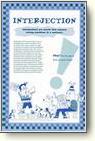 INTERJECTION
They are used to show shock, surprise, or anger on the part of the speaker, and to get attention. Usually, they are single words. You will see interjections in dialogue between people who are excited for some reason. You are most likely to see them in places like comic books and comic strips. Interjections are probably the easiest part of speech to identify. Unlike other parts of speech, they always appear with some sort of punctuation mark, usually an exclamation point. This sets them off from the rest of the sentence. Interjections should be used sparingly. Their function is to show an emotion on the part of the speaker or writer. Overusing them greatly lessens their effect.
|
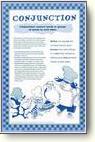 CONJUNCTION CONJUNCTION
Conjunctions are little words with a big job to do: they link up ideas, in the
form of words, phrases, and clauses, and they let you know how these words
relate to each other. Some of the best-known conjunctions include: and, but, and
or. There are three types of conjunctions.
Examples of subordinating conjunctions include: although, after, if, since, even though, because, unless, when
|
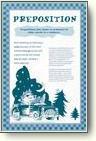
Prepositions join nouns or pronouns to
other words in a sentence. Together, the preposition and its object are called a "prepositional phrase." (Note: "of the preposition" is a prepositional phrase.) Prepositions tend to be words that help describe something, such as a time or place. Many - but not all - prepositions are little words. Some common prepositions include: around, against, before, between, over, under, in, on, of, at, by, from, with.
|
|
Parts of Speech Posters from Art.com
Read about : Content available at Art.com
|